The Broken Buddha
The Broken Buddha opens in Bangkok, makes a brief pilgrimage through India, and ends up on an ashram in the Arizona high desert, where the speaker struggles to come to terms with the long-ago death of his teenage daughter.
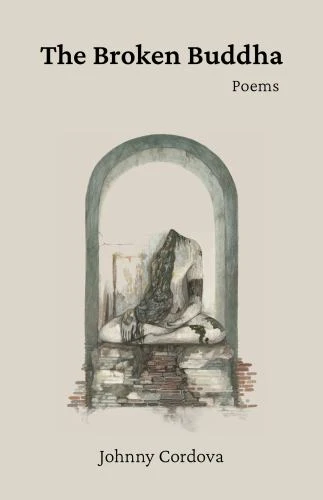
In the title poem, the speaker finds a kindred spirit in the marble statue of a Buddha whose head has been glued back in place. "I wander here now ruined through the wreckage of my burning," the speaker says--setting the stage for his journey through the red light districts of Bangkok and monasteries of Thailand, as he strives to reconcile commitment to a spiritual path with what Zen calls "the red thread of passion between one's legs."
Ancient poets Li Po, Ryokan, and Ikkyu each appear in prose poems set against present-day backdrops: a barbershop tucked into a narrow side street in northern Bangkok, an overnight train traveling from Bangkok to Chiang Mai, or a truck stop diner in the American West. The collection turns towards themes of death, loss, and the dharma of impermanence, and finally arrives at a quiet, if incomplete, redemption.
Characterized by a straightforward narrative style with sparing use of metaphor and a keen eye for detail, Johnny Cordova's debut collection is a spiritual journey in poems that at times are unflinchingly transgressive, but ultimately deeply and authentically human.
"Some books whisk you around the globe, some through time. Others take up shop somewhere near your soul. It's the rare book, though, that's capable of all three. Johnny Cordova's new collection, The Broken Buddha, is exactly THAT book. With equal parts history, travelogue, Zen, and self-revelation, these poems leave their mark on you page after page. As the title poem's narrator says, "I bought him because I want him to teach me." Grab a copy of this collection for that self-same reason."--Jack B. Bedell, author of Ghost Forest, Poet Laureate of Louisiana, 2017-2019
"In Johnny Cordova's marvelous The Broken Buddha, we find the act of breaking, and the act of healing in a counterpoint. One does not erase the other. He gives us narratives and lyrics that cross borders, nations, ashrams, oceans, the Oakland Raiders, bodies, burials, barbershops, monasteries, ladyboy bars, mountains, a father's basketball dreams, ghost towns, all in dialogue with the old masters from Asia to Arizona. Cordova offers us not words to heal the fractures, but to live with them, to own them. Because as he writes "once one is broken/ one stays broken/ even when they are able to glue/ your head back on.""--Sean Thomas Dougherty, author of Death Prefers the Minor Keys
"There aren't many writers who can make a collection of poetry read like a lyric novella by a sensitive, grown-up, ex-street poet, now a master. Never crass, always candid, Johnny Cordova can. And all with the clear phrasing of emotional and aesthetic maturity. Here is a poet whose spiritual aspirations, like those he hangs out with (Li Po, Ryokan, Ikkyu, fakirs and beggars, Jim Morrison), are bedded in the sensual floating world, which is sometimes ecstatic, sometimes heartbreaking, always true."--Richard Collins, Abbot of New Orleans Zen Temple, author of No Fear Zen and Stone Nest: Poems
After dropping out of the literary scene for 17 years, Johnny Cordova returned to writing poetry in 2021, upon returning from ten years in Southeast Asia. Recent work appears in Chicago Quarterly Review, Chiron Review, Louisiana Literature, Moon City Review, Soundings East, and elsewhere. He lives at Triveni Ashram, in northern Arizona, where he co-edits Shō Poetry Journal with his wife, poet Dominique Ahkong.
The Broken Buddha
The Broken Buddha opens in Bangkok, makes a brief pilgrimage through India, and ends up on an ashram in the Arizona high desert, where the speaker struggles to come to terms with the long-ago death of his teenage daughter.
In the title poem, the speaker finds a kindred spirit in the marble statue of a Buddha whose head has been glued back in place. "I wander here now ruined through the wreckage of my burning," the speaker says--setting the stage for his journey through the red light districts of Bangkok and monasteries of Thailand, as he strives to reconcile commitment to a spiritual path with what Zen calls "the red thread of passion between one's legs."
Ancient poets Li Po, Ryokan, and Ikkyu each appear in prose poems set against present-day backdrops: a barbershop tucked into a narrow side street in northern Bangkok, an overnight train traveling from Bangkok to Chiang Mai, or a truck stop diner in the American West. The collection turns towards themes of death, loss, and the dharma of impermanence, and finally arrives at a quiet, if incomplete, redemption.
Characterized by a straightforward narrative style with sparing use of metaphor and a keen eye for detail, Johnny Cordova's debut collection is a spiritual journey in poems that at times are unflinchingly transgressive, but ultimately deeply and authentically human.
"Some books whisk you around the globe, some through time. Others take up shop somewhere near your soul. It's the rare book, though, that's capable of all three. Johnny Cordova's new collection, The Broken Buddha, is exactly THAT book. With equal parts history, travelogue, Zen, and self-revelation, these poems leave their mark on you page after page. As the title poem's narrator says, "I bought him because I want him to teach me." Grab a copy of this collection for that self-same reason."--Jack B. Bedell, author of Ghost Forest, Poet Laureate of Louisiana, 2017-2019
"In Johnny Cordova's marvelous The Broken Buddha, we find the act of breaking, and the act of healing in a counterpoint. One does not erase the other. He gives us narratives and lyrics that cross borders, nations, ashrams, oceans, the Oakland Raiders, bodies, burials, barbershops, monasteries, ladyboy bars, mountains, a father's basketball dreams, ghost towns, all in dialogue with the old masters from Asia to Arizona. Cordova offers us not words to heal the fractures, but to live with them, to own them. Because as he writes "once one is broken/ one stays broken/ even when they are able to glue/ your head back on.""--Sean Thomas Dougherty, author of Death Prefers the Minor Keys
"There aren't many writers who can make a collection of poetry read like a lyric novella by a sensitive, grown-up, ex-street poet, now a master. Never crass, always candid, Johnny Cordova can. And all with the clear phrasing of emotional and aesthetic maturity. Here is a poet whose spiritual aspirations, like those he hangs out with (Li Po, Ryokan, Ikkyu, fakirs and beggars, Jim Morrison), are bedded in the sensual floating world, which is sometimes ecstatic, sometimes heartbreaking, always true."--Richard Collins, Abbot of New Orleans Zen Temple, author of No Fear Zen and Stone Nest: Poems
After dropping out of the literary scene for 17 years, Johnny Cordova returned to writing poetry in 2021, upon returning from ten years in Southeast Asia. Recent work appears in Chicago Quarterly Review, Chiron Review, Louisiana Literature, Moon City Review, Soundings East, and elsewhere. He lives at Triveni Ashram, in northern Arizona, where he co-edits Shō Poetry Journal with his wife, poet Dominique Ahkong.
Product Information
Product Information
Shipping & Returns
Shipping & Returns
Description
The Broken Buddha opens in Bangkok, makes a brief pilgrimage through India, and ends up on an ashram in the Arizona high desert, where the speaker struggles to come to terms with the long-ago death of his teenage daughter.
In the title poem, the speaker finds a kindred spirit in the marble statue of a Buddha whose head has been glued back in place. "I wander here now ruined through the wreckage of my burning," the speaker says--setting the stage for his journey through the red light districts of Bangkok and monasteries of Thailand, as he strives to reconcile commitment to a spiritual path with what Zen calls "the red thread of passion between one's legs."
Ancient poets Li Po, Ryokan, and Ikkyu each appear in prose poems set against present-day backdrops: a barbershop tucked into a narrow side street in northern Bangkok, an overnight train traveling from Bangkok to Chiang Mai, or a truck stop diner in the American West. The collection turns towards themes of death, loss, and the dharma of impermanence, and finally arrives at a quiet, if incomplete, redemption.
Characterized by a straightforward narrative style with sparing use of metaphor and a keen eye for detail, Johnny Cordova's debut collection is a spiritual journey in poems that at times are unflinchingly transgressive, but ultimately deeply and authentically human.
"Some books whisk you around the globe, some through time. Others take up shop somewhere near your soul. It's the rare book, though, that's capable of all three. Johnny Cordova's new collection, The Broken Buddha, is exactly THAT book. With equal parts history, travelogue, Zen, and self-revelation, these poems leave their mark on you page after page. As the title poem's narrator says, "I bought him because I want him to teach me." Grab a copy of this collection for that self-same reason."--Jack B. Bedell, author of Ghost Forest, Poet Laureate of Louisiana, 2017-2019
"In Johnny Cordova's marvelous The Broken Buddha, we find the act of breaking, and the act of healing in a counterpoint. One does not erase the other. He gives us narratives and lyrics that cross borders, nations, ashrams, oceans, the Oakland Raiders, bodies, burials, barbershops, monasteries, ladyboy bars, mountains, a father's basketball dreams, ghost towns, all in dialogue with the old masters from Asia to Arizona. Cordova offers us not words to heal the fractures, but to live with them, to own them. Because as he writes "once one is broken/ one stays broken/ even when they are able to glue/ your head back on.""--Sean Thomas Dougherty, author of Death Prefers the Minor Keys
"There aren't many writers who can make a collection of poetry read like a lyric novella by a sensitive, grown-up, ex-street poet, now a master. Never crass, always candid, Johnny Cordova can. And all with the clear phrasing of emotional and aesthetic maturity. Here is a poet whose spiritual aspirations, like those he hangs out with (Li Po, Ryokan, Ikkyu, fakirs and beggars, Jim Morrison), are bedded in the sensual floating world, which is sometimes ecstatic, sometimes heartbreaking, always true."--Richard Collins, Abbot of New Orleans Zen Temple, author of No Fear Zen and Stone Nest: Poems
After dropping out of the literary scene for 17 years, Johnny Cordova returned to writing poetry in 2021, upon returning from ten years in Southeast Asia. Recent work appears in Chicago Quarterly Review, Chiron Review, Louisiana Literature, Moon City Review, Soundings East, and elsewhere. He lives at Triveni Ashram, in northern Arizona, where he co-edits Shō Poetry Journal with his wife, poet Dominique Ahkong.