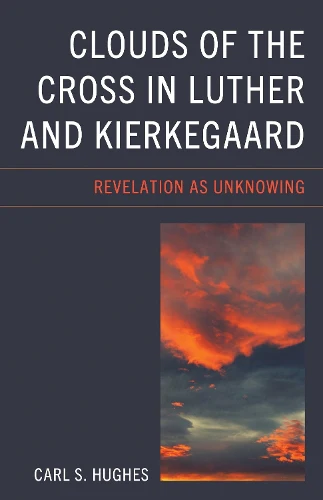
Clouds of the Cross in Luther and Kierkegaard
What do Christians mean when they talk about revelation? What sort of truth do Jesus and the Bible disclose? Knowledge or doctrine, required beliefs or a moral code, the answers Christians give to these questions tend to be objective in form: something they “have” that others lack. In Clouds of the Cross in Luther and Kierkegaard: Revelation as Unknowing, Carl S. Hughes draws on Martin Luther and Søren Kierkegaard—two of the most Christocentric and biblically oriented theologians in history—to suggest a much-needed alternative.
Hughes blends historical, philosophical, and constructive approaches to theology in lively and engaging prose. He spotlights the objectifying tendencies in Luther’s thought that become so influential in modernity, while also finding resources in Luther’s own theology for a very different approach. Then, Hughes turns to Søren Kierkegaard—one of Luther’s fiercest critics and, at the same time, most faithful inheritors. Hughes argues that Kierkegaard carries some of Luther’s most provocative themes further than Luther himself ever dares. The result is a “Kierkegaardian-Lutheran” theology of revelation that resonates with mystical and apophatic theology, resembles art more than information, and transforms lives to incarnate the love of Christ in diverse and ever-changing ways.
Clouds of the Cross in Luther and Kierkegaard
What do Christians mean when they talk about revelation? What sort of truth do Jesus and the Bible disclose? Knowledge or doctrine, required beliefs or a moral code, the answers Christians give to these questions tend to be objective in form: something they “have” that others lack. In Clouds of the Cross in Luther and Kierkegaard: Revelation as Unknowing, Carl S. Hughes draws on Martin Luther and Søren Kierkegaard—two of the most Christocentric and biblically oriented theologians in history—to suggest a much-needed alternative.
Hughes blends historical, philosophical, and constructive approaches to theology in lively and engaging prose. He spotlights the objectifying tendencies in Luther’s thought that become so influential in modernity, while also finding resources in Luther’s own theology for a very different approach. Then, Hughes turns to Søren Kierkegaard—one of Luther’s fiercest critics and, at the same time, most faithful inheritors. Hughes argues that Kierkegaard carries some of Luther’s most provocative themes further than Luther himself ever dares. The result is a “Kierkegaardian-Lutheran” theology of revelation that resonates with mystical and apophatic theology, resembles art more than information, and transforms lives to incarnate the love of Christ in diverse and ever-changing ways.
Product Information
Product Information
Shipping & Returns
Shipping & Returns
Description
What do Christians mean when they talk about revelation? What sort of truth do Jesus and the Bible disclose? Knowledge or doctrine, required beliefs or a moral code, the answers Christians give to these questions tend to be objective in form: something they “have” that others lack. In Clouds of the Cross in Luther and Kierkegaard: Revelation as Unknowing, Carl S. Hughes draws on Martin Luther and Søren Kierkegaard—two of the most Christocentric and biblically oriented theologians in history—to suggest a much-needed alternative.
Hughes blends historical, philosophical, and constructive approaches to theology in lively and engaging prose. He spotlights the objectifying tendencies in Luther’s thought that become so influential in modernity, while also finding resources in Luther’s own theology for a very different approach. Then, Hughes turns to Søren Kierkegaard—one of Luther’s fiercest critics and, at the same time, most faithful inheritors. Hughes argues that Kierkegaard carries some of Luther’s most provocative themes further than Luther himself ever dares. The result is a “Kierkegaardian-Lutheran” theology of revelation that resonates with mystical and apophatic theology, resembles art more than information, and transforms lives to incarnate the love of Christ in diverse and ever-changing ways.