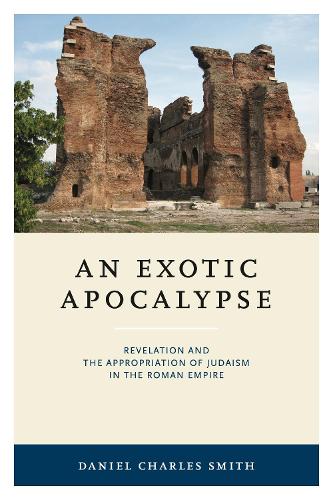
An Exotic Apocalypse
The book of Revelation has long fascinated readers with its strange symbols, dramatic visions, and apocalyptic warnings. Yet debates about whether it is fundamentally a Christian or Jewish text obscure the political world that gave rise to it. An Exotic Apocalypse offers a new way of understanding Revelation by situating it within the vibrant and experimental religious culture of Roman Asia Minor.
Daniel Charles Smith argues that the question of Christian versus Jewish origins rests on distinctions that did not exist in the first century. Instead, he shows how the Apocalypse emerged within a broader fascination with “exotic” religious practices in the Roman world—especially those associated with Judea. John of Patmos drew on the allure, mystery, and political charge surrounding Judea to craft a compellingly “exotic” religious vision, one whose power depended on imperial structures that defined which customs seemed foreign, dangerous, or appealing. Blending insights from archaeology, imperial history, and the study of ancient religion, Smith reveals how Revelation’s vivid imagery and apocalyptic language arose from a cultural crossroads shaped by empire, identity, and imagination.
An Exotic Apocalypse offers a fresh perspective on one of antiquity’s most enigmatic texts and illuminates how communities in the Roman world made meaning from foreign traditions. It will appeal to scholars and students of biblical studies, ancient Judaism and Christianity, and Roman religion, as well as readers interested in how communities made meaning from tradition, identity, and empire.
Original: $115.99
-65%$115.99
$40.60An Exotic Apocalypse
The book of Revelation has long fascinated readers with its strange symbols, dramatic visions, and apocalyptic warnings. Yet debates about whether it is fundamentally a Christian or Jewish text obscure the political world that gave rise to it. An Exotic Apocalypse offers a new way of understanding Revelation by situating it within the vibrant and experimental religious culture of Roman Asia Minor.
Daniel Charles Smith argues that the question of Christian versus Jewish origins rests on distinctions that did not exist in the first century. Instead, he shows how the Apocalypse emerged within a broader fascination with “exotic” religious practices in the Roman world—especially those associated with Judea. John of Patmos drew on the allure, mystery, and political charge surrounding Judea to craft a compellingly “exotic” religious vision, one whose power depended on imperial structures that defined which customs seemed foreign, dangerous, or appealing. Blending insights from archaeology, imperial history, and the study of ancient religion, Smith reveals how Revelation’s vivid imagery and apocalyptic language arose from a cultural crossroads shaped by empire, identity, and imagination.
An Exotic Apocalypse offers a fresh perspective on one of antiquity’s most enigmatic texts and illuminates how communities in the Roman world made meaning from foreign traditions. It will appeal to scholars and students of biblical studies, ancient Judaism and Christianity, and Roman religion, as well as readers interested in how communities made meaning from tradition, identity, and empire.
Product Information
Product Information
Shipping & Returns
Shipping & Returns
Description
The book of Revelation has long fascinated readers with its strange symbols, dramatic visions, and apocalyptic warnings. Yet debates about whether it is fundamentally a Christian or Jewish text obscure the political world that gave rise to it. An Exotic Apocalypse offers a new way of understanding Revelation by situating it within the vibrant and experimental religious culture of Roman Asia Minor.
Daniel Charles Smith argues that the question of Christian versus Jewish origins rests on distinctions that did not exist in the first century. Instead, he shows how the Apocalypse emerged within a broader fascination with “exotic” religious practices in the Roman world—especially those associated with Judea. John of Patmos drew on the allure, mystery, and political charge surrounding Judea to craft a compellingly “exotic” religious vision, one whose power depended on imperial structures that defined which customs seemed foreign, dangerous, or appealing. Blending insights from archaeology, imperial history, and the study of ancient religion, Smith reveals how Revelation’s vivid imagery and apocalyptic language arose from a cultural crossroads shaped by empire, identity, and imagination.
An Exotic Apocalypse offers a fresh perspective on one of antiquity’s most enigmatic texts and illuminates how communities in the Roman world made meaning from foreign traditions. It will appeal to scholars and students of biblical studies, ancient Judaism and Christianity, and Roman religion, as well as readers interested in how communities made meaning from tradition, identity, and empire.