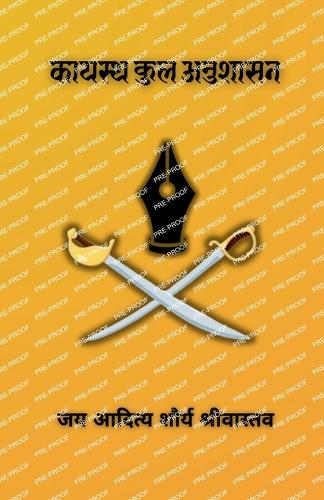
Kayastha Kula Anushasan
For the execution of the acts of creation (utpatti), sustenance (sthiti), dissolution (saṁhāra), restraint (nigraha), and grace (anugraha) of the universe, Bhagavān, the Sat-cit-ānanda-svarūpa Sarveśvara (Supreme Lord of Existence-Consciousness-Bliss), revealed Himself in this world as Hiraṇyagarbhātmaka Brahmā (the creator), Viṣṇu (the sustainer), Śiva (the dissolver), Śakti as the power of restraint, and Gaṇeśa as the embodiment of grace. On the philosophical plane, Bhagavān alone is proven to be the abhinna-nimitta-upādāna kāraṇa (non-different efficient and material cause) of this creation. That very Sat-cit-ānanda-kanda Bhagavān manifests Himself in this world as Prakṛti, and it's pa catattvātmikā śakti. Moreover, He also expresses Himself in all forms, thereby establishing His sarvarūpatā (all-form encompassing nature). It is by Bhagavān's grace that each of the five elements gives rise to a corresponding indriya (sense), and through the aid of ahaṅkāra-catuṣṭaya (the fourfold ego), the jīva, who is a reflection of Bhagavān Himself, perceives the world. Furthermore, it should be meditated upon that Bhagavān alone is the origin of both lineage (vaṁśa) and guru-paramparā (lineage of teachers) in this world. From Him arise both these traditions. Of these, the uninterrupted lineage (avicchinna vaṁśa-paramparā) is what is designated by the term varṇāśrama. Therefore, the Nāda and Bindu traditions must be protected.
This book is a humble effort in that very direction.
Kayastha Kula Anushasan
For the execution of the acts of creation (utpatti), sustenance (sthiti), dissolution (saṁhāra), restraint (nigraha), and grace (anugraha) of the universe, Bhagavān, the Sat-cit-ānanda-svarūpa Sarveśvara (Supreme Lord of Existence-Consciousness-Bliss), revealed Himself in this world as Hiraṇyagarbhātmaka Brahmā (the creator), Viṣṇu (the sustainer), Śiva (the dissolver), Śakti as the power of restraint, and Gaṇeśa as the embodiment of grace. On the philosophical plane, Bhagavān alone is proven to be the abhinna-nimitta-upādāna kāraṇa (non-different efficient and material cause) of this creation. That very Sat-cit-ānanda-kanda Bhagavān manifests Himself in this world as Prakṛti, and it's pa catattvātmikā śakti. Moreover, He also expresses Himself in all forms, thereby establishing His sarvarūpatā (all-form encompassing nature). It is by Bhagavān's grace that each of the five elements gives rise to a corresponding indriya (sense), and through the aid of ahaṅkāra-catuṣṭaya (the fourfold ego), the jīva, who is a reflection of Bhagavān Himself, perceives the world. Furthermore, it should be meditated upon that Bhagavān alone is the origin of both lineage (vaṁśa) and guru-paramparā (lineage of teachers) in this world. From Him arise both these traditions. Of these, the uninterrupted lineage (avicchinna vaṁśa-paramparā) is what is designated by the term varṇāśrama. Therefore, the Nāda and Bindu traditions must be protected.
This book is a humble effort in that very direction.
Product Information
Product Information
Shipping & Returns
Shipping & Returns
Description
For the execution of the acts of creation (utpatti), sustenance (sthiti), dissolution (saṁhāra), restraint (nigraha), and grace (anugraha) of the universe, Bhagavān, the Sat-cit-ānanda-svarūpa Sarveśvara (Supreme Lord of Existence-Consciousness-Bliss), revealed Himself in this world as Hiraṇyagarbhātmaka Brahmā (the creator), Viṣṇu (the sustainer), Śiva (the dissolver), Śakti as the power of restraint, and Gaṇeśa as the embodiment of grace. On the philosophical plane, Bhagavān alone is proven to be the abhinna-nimitta-upādāna kāraṇa (non-different efficient and material cause) of this creation. That very Sat-cit-ānanda-kanda Bhagavān manifests Himself in this world as Prakṛti, and it's pa catattvātmikā śakti. Moreover, He also expresses Himself in all forms, thereby establishing His sarvarūpatā (all-form encompassing nature). It is by Bhagavān's grace that each of the five elements gives rise to a corresponding indriya (sense), and through the aid of ahaṅkāra-catuṣṭaya (the fourfold ego), the jīva, who is a reflection of Bhagavān Himself, perceives the world. Furthermore, it should be meditated upon that Bhagavān alone is the origin of both lineage (vaṁśa) and guru-paramparā (lineage of teachers) in this world. From Him arise both these traditions. Of these, the uninterrupted lineage (avicchinna vaṁśa-paramparā) is what is designated by the term varṇāśrama. Therefore, the Nāda and Bindu traditions must be protected.
This book is a humble effort in that very direction.