🎉 Up to 70% Off Selected ItemsShop Sale

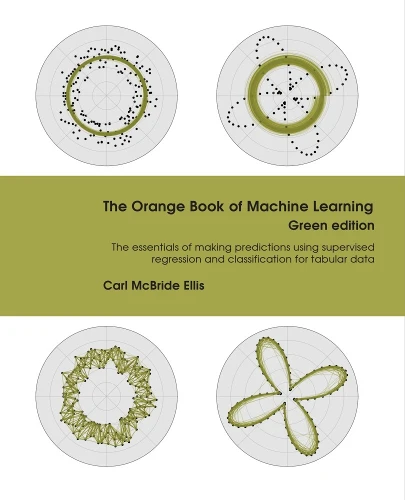
The Orange Book of Machine Learning Green Edition
Learn supervised machine learning for tabular data using Python, pandas, scikit-learn, CatBoost, LightGBM, XGBoost, TabPFN, and TabICL for regression, classification, and predictive modeling
Key Features
Explore, clean, and prepare tabular datasets for machine learning workflows
Build regression and classification models using modern machine learning tools
Improve predictions with calibration, conformal intervals, and optimization techniques
Book DescriptionMaster the essential tools and techniques for supervised machine learning on tabular data with this practical guide to regression and classification. Through clear explanations, code snippets, and hands-on notebooks, you'll learn how to use Python and leading machine learning libraries, including pandas, scikit-learn, CatBoost, LightGBM, XGBoost, TabPFN, and TabICL, to build predictive models for real-world datasets.
The book covers the complete workflow, from data exploration and cleaning to model development, evaluation, and optimization. You'll learn how to perform regression analysis for accurate point predictions and estimate uncertainty using conformal prediction intervals. For classification tasks, you'll explore probabilistic predictions and calibration techniques to improve model reliability. You'll also discover practical approaches to feature engineering, feature selection, and hyperparameter optimization to enhance model performance. In addition, the book introduces tabular foundation models and in-context learning techniques, providing insight into the latest advances in machine learning for structured data.
By the end of the book, you'll have the skills and confidence to develop, evaluate, and deploy supervised machine learning models for a wide range of tabular data applications.What you will learn
Perform exploratory data analysis and data cleaning
Apply cross-validation for reliable model evaluation
Build regression models and prediction intervals
Develop calibrated probabilistic classification models
Optimize models through hyperparameter tuning
Engineer and select features for improved performance
Use ensemble learning methods effectively
Explore tabular foundation models and in-context learning
Who this book is forThis book is designed for motivated self-learners, university students studying applied machine learning, junior data scientists, and academic researchers looking to incorporate machine learning into their analytical workflows. Readers should have a basic familiarity with Python and data analysis concepts. Whether you're developing predictive models for business, research, or educational purposes, this book provides the practical guidance needed to apply modern machine learning techniques to structured and tabular datasets.
$50.89
The Orange Book of Machine Learning Green Edition—
$50.89
The Orange Book of Machine Learning Green Edition
Learn supervised machine learning for tabular data using Python, pandas, scikit-learn, CatBoost, LightGBM, XGBoost, TabPFN, and TabICL for regression, classification, and predictive modeling
Key Features
Explore, clean, and prepare tabular datasets for machine learning workflows
Build regression and classification models using modern machine learning tools
Improve predictions with calibration, conformal intervals, and optimization techniques
Book DescriptionMaster the essential tools and techniques for supervised machine learning on tabular data with this practical guide to regression and classification. Through clear explanations, code snippets, and hands-on notebooks, you'll learn how to use Python and leading machine learning libraries, including pandas, scikit-learn, CatBoost, LightGBM, XGBoost, TabPFN, and TabICL, to build predictive models for real-world datasets.
The book covers the complete workflow, from data exploration and cleaning to model development, evaluation, and optimization. You'll learn how to perform regression analysis for accurate point predictions and estimate uncertainty using conformal prediction intervals. For classification tasks, you'll explore probabilistic predictions and calibration techniques to improve model reliability. You'll also discover practical approaches to feature engineering, feature selection, and hyperparameter optimization to enhance model performance. In addition, the book introduces tabular foundation models and in-context learning techniques, providing insight into the latest advances in machine learning for structured data.
By the end of the book, you'll have the skills and confidence to develop, evaluate, and deploy supervised machine learning models for a wide range of tabular data applications.What you will learn
Perform exploratory data analysis and data cleaning
Apply cross-validation for reliable model evaluation
Build regression models and prediction intervals
Develop calibrated probabilistic classification models
Optimize models through hyperparameter tuning
Engineer and select features for improved performance
Use ensemble learning methods effectively
Explore tabular foundation models and in-context learning
Who this book is forThis book is designed for motivated self-learners, university students studying applied machine learning, junior data scientists, and academic researchers looking to incorporate machine learning into their analytical workflows. Readers should have a basic familiarity with Python and data analysis concepts. Whether you're developing predictive models for business, research, or educational purposes, this book provides the practical guidance needed to apply modern machine learning techniques to structured and tabular datasets.
Product Information
Product Information
Shipping & Returns
Shipping & Returns
Description
Learn supervised machine learning for tabular data using Python, pandas, scikit-learn, CatBoost, LightGBM, XGBoost, TabPFN, and TabICL for regression, classification, and predictive modeling
Key Features
Explore, clean, and prepare tabular datasets for machine learning workflows
Build regression and classification models using modern machine learning tools
Improve predictions with calibration, conformal intervals, and optimization techniques
Book DescriptionMaster the essential tools and techniques for supervised machine learning on tabular data with this practical guide to regression and classification. Through clear explanations, code snippets, and hands-on notebooks, you'll learn how to use Python and leading machine learning libraries, including pandas, scikit-learn, CatBoost, LightGBM, XGBoost, TabPFN, and TabICL, to build predictive models for real-world datasets.
The book covers the complete workflow, from data exploration and cleaning to model development, evaluation, and optimization. You'll learn how to perform regression analysis for accurate point predictions and estimate uncertainty using conformal prediction intervals. For classification tasks, you'll explore probabilistic predictions and calibration techniques to improve model reliability. You'll also discover practical approaches to feature engineering, feature selection, and hyperparameter optimization to enhance model performance. In addition, the book introduces tabular foundation models and in-context learning techniques, providing insight into the latest advances in machine learning for structured data.
By the end of the book, you'll have the skills and confidence to develop, evaluate, and deploy supervised machine learning models for a wide range of tabular data applications.What you will learn
Perform exploratory data analysis and data cleaning
Apply cross-validation for reliable model evaluation
Build regression models and prediction intervals
Develop calibrated probabilistic classification models
Optimize models through hyperparameter tuning
Engineer and select features for improved performance
Use ensemble learning methods effectively
Explore tabular foundation models and in-context learning
Who this book is forThis book is designed for motivated self-learners, university students studying applied machine learning, junior data scientists, and academic researchers looking to incorporate machine learning into their analytical workflows. Readers should have a basic familiarity with Python and data analysis concepts. Whether you're developing predictive models for business, research, or educational purposes, this book provides the practical guidance needed to apply modern machine learning techniques to structured and tabular datasets.