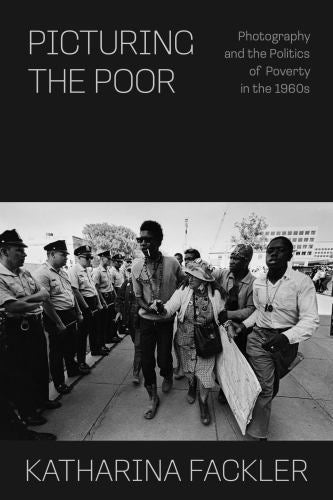
Picturing the Poor
Throughout the 1960s—from the War on Poverty to the 1968 Poor People’s Campaign—Americans fiercely debated what the persistence of poverty meant for the United States. Picturing the Poor examines an array of rarely seen social documentary photographs to show that debates over poverty were also debates over the right ways of seeing, feeling, and knowing.
When the public “rediscovered” poverty in the late 1950s and 1960s, photography played a crucial role in shaping how the problem was imagined. This book traces how social actors, including the Lyndon B. Johnson administration, the magazine Look, and grassroots activists, used images to influence public perception. Katharina Fackler argues that social documentary photography was revitalized, remodeled, and contested in the process. As Cold War geopolitics and the Civil Rights Movement reshaped ideas of democracy, photographs raised urgent questions: Who could portray poverty? Whose suffering would be visible? And to whose sensibilities should such images appeal?
By analyzing photographs within their social and sensory contexts, Picturing the Poor reveals how images mediated the politics of poverty, navigating racialized, gendered, and classed habits of feeling while making ambivalent interventions in debates over social justice. This book will fascinate scholars, students, and general readers interested in the 1960s, visual culture, and the intertwined histories of poverty, politics, and social change.
Original: $115.99
-65%$115.99
$40.60Picturing the Poor
Throughout the 1960s—from the War on Poverty to the 1968 Poor People’s Campaign—Americans fiercely debated what the persistence of poverty meant for the United States. Picturing the Poor examines an array of rarely seen social documentary photographs to show that debates over poverty were also debates over the right ways of seeing, feeling, and knowing.
When the public “rediscovered” poverty in the late 1950s and 1960s, photography played a crucial role in shaping how the problem was imagined. This book traces how social actors, including the Lyndon B. Johnson administration, the magazine Look, and grassroots activists, used images to influence public perception. Katharina Fackler argues that social documentary photography was revitalized, remodeled, and contested in the process. As Cold War geopolitics and the Civil Rights Movement reshaped ideas of democracy, photographs raised urgent questions: Who could portray poverty? Whose suffering would be visible? And to whose sensibilities should such images appeal?
By analyzing photographs within their social and sensory contexts, Picturing the Poor reveals how images mediated the politics of poverty, navigating racialized, gendered, and classed habits of feeling while making ambivalent interventions in debates over social justice. This book will fascinate scholars, students, and general readers interested in the 1960s, visual culture, and the intertwined histories of poverty, politics, and social change.
Product Information
Product Information
Shipping & Returns
Shipping & Returns
Description
Throughout the 1960s—from the War on Poverty to the 1968 Poor People’s Campaign—Americans fiercely debated what the persistence of poverty meant for the United States. Picturing the Poor examines an array of rarely seen social documentary photographs to show that debates over poverty were also debates over the right ways of seeing, feeling, and knowing.
When the public “rediscovered” poverty in the late 1950s and 1960s, photography played a crucial role in shaping how the problem was imagined. This book traces how social actors, including the Lyndon B. Johnson administration, the magazine Look, and grassroots activists, used images to influence public perception. Katharina Fackler argues that social documentary photography was revitalized, remodeled, and contested in the process. As Cold War geopolitics and the Civil Rights Movement reshaped ideas of democracy, photographs raised urgent questions: Who could portray poverty? Whose suffering would be visible? And to whose sensibilities should such images appeal?
By analyzing photographs within their social and sensory contexts, Picturing the Poor reveals how images mediated the politics of poverty, navigating racialized, gendered, and classed habits of feeling while making ambivalent interventions in debates over social justice. This book will fascinate scholars, students, and general readers interested in the 1960s, visual culture, and the intertwined histories of poverty, politics, and social change.