Powering Colonialism
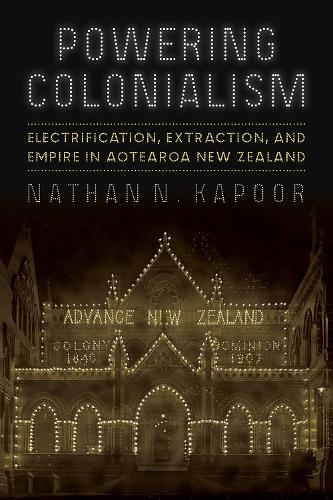
Powering Colonialism explores the history of electrification and its relationship to colonialism in Aotearoa New Zealand. Exploitative electric infrastructure, Nathan N. Kapoor argues, was not inevitable, and it was not determined by geography or a coincidence of colonization—it was by design. By the twenty-first century, hydropower provided more than half the country’s electricity. Although it is now lauded as a renewable energy source, advocates for the earliest hydroelectrification schemes were more concerned with extracting greater profits and highlighting British technological superiority. Settlers, miners, and politicians saw electricity as a tool for achieving modernity, wealth, and self-sufficiency, and Aotearoa New Zealand’s vast river system, once a barrier to colonial expansion, was now used to justify it. The electrification projects Kapoor examines in Powering Colonialism—from hydroelectric power for gold mining in the 1880s to Māori-led geothermal energy plants in use today—illustrate how, from the very beginning of Aotearoa New Zealand’s transition to electric power, settlers designed and used electric power systems in service to their colonial mission.
Powering Colonialism
Powering Colonialism explores the history of electrification and its relationship to colonialism in Aotearoa New Zealand. Exploitative electric infrastructure, Nathan N. Kapoor argues, was not inevitable, and it was not determined by geography or a coincidence of colonization—it was by design. By the twenty-first century, hydropower provided more than half the country’s electricity. Although it is now lauded as a renewable energy source, advocates for the earliest hydroelectrification schemes were more concerned with extracting greater profits and highlighting British technological superiority. Settlers, miners, and politicians saw electricity as a tool for achieving modernity, wealth, and self-sufficiency, and Aotearoa New Zealand’s vast river system, once a barrier to colonial expansion, was now used to justify it. The electrification projects Kapoor examines in Powering Colonialism—from hydroelectric power for gold mining in the 1880s to Māori-led geothermal energy plants in use today—illustrate how, from the very beginning of Aotearoa New Zealand’s transition to electric power, settlers designed and used electric power systems in service to their colonial mission.
Product Information
Product Information
Shipping & Returns
Shipping & Returns
Description
Powering Colonialism explores the history of electrification and its relationship to colonialism in Aotearoa New Zealand. Exploitative electric infrastructure, Nathan N. Kapoor argues, was not inevitable, and it was not determined by geography or a coincidence of colonization—it was by design. By the twenty-first century, hydropower provided more than half the country’s electricity. Although it is now lauded as a renewable energy source, advocates for the earliest hydroelectrification schemes were more concerned with extracting greater profits and highlighting British technological superiority. Settlers, miners, and politicians saw electricity as a tool for achieving modernity, wealth, and self-sufficiency, and Aotearoa New Zealand’s vast river system, once a barrier to colonial expansion, was now used to justify it. The electrification projects Kapoor examines in Powering Colonialism—from hydroelectric power for gold mining in the 1880s to Māori-led geothermal energy plants in use today—illustrate how, from the very beginning of Aotearoa New Zealand’s transition to electric power, settlers designed and used electric power systems in service to their colonial mission.