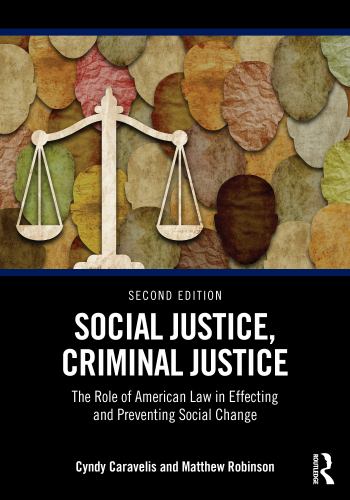
Social Justice, Criminal Justice
Social Justice, Criminal Justice is the first book of its kind to fully integrate criminal justice practice (i.e. policing, courts, and corrections) with foundational theories of justice (i.e. including utilitarianism, libertarianism, egalitarianism, and virtue-based frameworks).
Grounded in legal thought and constitutional principles, the authors critically examine how discrimination became embedded in U.S. law, contributing to the perpetuation and maintenance of a system that excluded racial and ethnic minorities, the poor, women, and members of the LGBTQ community. At the same time, the book demonstrates how those very legal structures have been challenged, reinterpreted, and mobilized to dismantle injustice. The pursuit of a more just society continues today, in courtrooms, legislatures, and communities across the nation. Unlike any other book on the market, this book provides the reader with a solid understanding of how discrimination by race, ethnicity, social class, gender, sexual orientation, and other extra-legal factors was created, but also how that discrimination continues to be overcome. What truly distinguishes this book is its direct and sustained connection between everyday criminal justice practice and the major theories of justice that shape American law and governance. Readers learn how each theory is rooted in constitutional values and how liberty, equality, happiness, and morality remain central to the American legal tradition.
Designed for undergraduate and graduate students in criminal justice, criminology, political science, law, public administration, and related fields, this groundbreaking work also serves as an essential resource for scholars examining criminal justice, criminal law, and the ongoing struggle for justice in the United States.
Original: $66.09
-65%$66.09
$23.13Social Justice, Criminal Justice
Social Justice, Criminal Justice is the first book of its kind to fully integrate criminal justice practice (i.e. policing, courts, and corrections) with foundational theories of justice (i.e. including utilitarianism, libertarianism, egalitarianism, and virtue-based frameworks).
Grounded in legal thought and constitutional principles, the authors critically examine how discrimination became embedded in U.S. law, contributing to the perpetuation and maintenance of a system that excluded racial and ethnic minorities, the poor, women, and members of the LGBTQ community. At the same time, the book demonstrates how those very legal structures have been challenged, reinterpreted, and mobilized to dismantle injustice. The pursuit of a more just society continues today, in courtrooms, legislatures, and communities across the nation. Unlike any other book on the market, this book provides the reader with a solid understanding of how discrimination by race, ethnicity, social class, gender, sexual orientation, and other extra-legal factors was created, but also how that discrimination continues to be overcome. What truly distinguishes this book is its direct and sustained connection between everyday criminal justice practice and the major theories of justice that shape American law and governance. Readers learn how each theory is rooted in constitutional values and how liberty, equality, happiness, and morality remain central to the American legal tradition.
Designed for undergraduate and graduate students in criminal justice, criminology, political science, law, public administration, and related fields, this groundbreaking work also serves as an essential resource for scholars examining criminal justice, criminal law, and the ongoing struggle for justice in the United States.
Product Information
Product Information
Shipping & Returns
Shipping & Returns
Description
Social Justice, Criminal Justice is the first book of its kind to fully integrate criminal justice practice (i.e. policing, courts, and corrections) with foundational theories of justice (i.e. including utilitarianism, libertarianism, egalitarianism, and virtue-based frameworks).
Grounded in legal thought and constitutional principles, the authors critically examine how discrimination became embedded in U.S. law, contributing to the perpetuation and maintenance of a system that excluded racial and ethnic minorities, the poor, women, and members of the LGBTQ community. At the same time, the book demonstrates how those very legal structures have been challenged, reinterpreted, and mobilized to dismantle injustice. The pursuit of a more just society continues today, in courtrooms, legislatures, and communities across the nation. Unlike any other book on the market, this book provides the reader with a solid understanding of how discrimination by race, ethnicity, social class, gender, sexual orientation, and other extra-legal factors was created, but also how that discrimination continues to be overcome. What truly distinguishes this book is its direct and sustained connection between everyday criminal justice practice and the major theories of justice that shape American law and governance. Readers learn how each theory is rooted in constitutional values and how liberty, equality, happiness, and morality remain central to the American legal tradition.
Designed for undergraduate and graduate students in criminal justice, criminology, political science, law, public administration, and related fields, this groundbreaking work also serves as an essential resource for scholars examining criminal justice, criminal law, and the ongoing struggle for justice in the United States.