The Subversive Pulpit
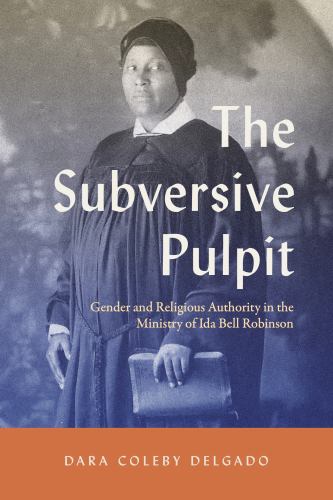
When the United Holy Church of America moved to curtail women’s ordination in 1924, Ida Bell Robinson broke away to found a church where women would not only preach but lead. The Subversive Pulpit argues that Robinson used her agency and autonomy amid the upheavals of the Great Migration to build a religious enterprise defined by radical gender egalitarianism and socioeconomic uplift for Black women and their communities.
Centering Robinson as founder and first bishop of the Mount Sinai Holy Church of America, Dara Coleby Delgado shows how her religious program extended far beyond the question of whether women should preach. Drawing on unpublished denominational records, census data, the Black Press, and other archival sources, Delgado interprets Robinson’s efforts to “loose the women” as a practical, economically consequential project. Robinson transformed the pulpit into a subversive site—one that generated social capital, fostered positive religio-racial identity, and created jobs and institutional opportunities aligned with Progressive Era urban culture, industrialism, and commercial expansion.
By recovering Robinson as both a religious influencer and business-minded institution builder, Delgado reframes her legacy as a model of holiness, spiritual empowerment, and prophetic social consciousness. The book makes a significant contribution to scholarship on American Pentecostalism, African American religion, and women’s religious leadership, and will be essential reading for scholars and students of American religious history, Black church studies, gender studies, and women’s history.
The Subversive Pulpit
When the United Holy Church of America moved to curtail women’s ordination in 1924, Ida Bell Robinson broke away to found a church where women would not only preach but lead. The Subversive Pulpit argues that Robinson used her agency and autonomy amid the upheavals of the Great Migration to build a religious enterprise defined by radical gender egalitarianism and socioeconomic uplift for Black women and their communities.
Centering Robinson as founder and first bishop of the Mount Sinai Holy Church of America, Dara Coleby Delgado shows how her religious program extended far beyond the question of whether women should preach. Drawing on unpublished denominational records, census data, the Black Press, and other archival sources, Delgado interprets Robinson’s efforts to “loose the women” as a practical, economically consequential project. Robinson transformed the pulpit into a subversive site—one that generated social capital, fostered positive religio-racial identity, and created jobs and institutional opportunities aligned with Progressive Era urban culture, industrialism, and commercial expansion.
By recovering Robinson as both a religious influencer and business-minded institution builder, Delgado reframes her legacy as a model of holiness, spiritual empowerment, and prophetic social consciousness. The book makes a significant contribution to scholarship on American Pentecostalism, African American religion, and women’s religious leadership, and will be essential reading for scholars and students of American religious history, Black church studies, gender studies, and women’s history.
Product Information
Product Information
Shipping & Returns
Shipping & Returns
Description
When the United Holy Church of America moved to curtail women’s ordination in 1924, Ida Bell Robinson broke away to found a church where women would not only preach but lead. The Subversive Pulpit argues that Robinson used her agency and autonomy amid the upheavals of the Great Migration to build a religious enterprise defined by radical gender egalitarianism and socioeconomic uplift for Black women and their communities.
Centering Robinson as founder and first bishop of the Mount Sinai Holy Church of America, Dara Coleby Delgado shows how her religious program extended far beyond the question of whether women should preach. Drawing on unpublished denominational records, census data, the Black Press, and other archival sources, Delgado interprets Robinson’s efforts to “loose the women” as a practical, economically consequential project. Robinson transformed the pulpit into a subversive site—one that generated social capital, fostered positive religio-racial identity, and created jobs and institutional opportunities aligned with Progressive Era urban culture, industrialism, and commercial expansion.
By recovering Robinson as both a religious influencer and business-minded institution builder, Delgado reframes her legacy as a model of holiness, spiritual empowerment, and prophetic social consciousness. The book makes a significant contribution to scholarship on American Pentecostalism, African American religion, and women’s religious leadership, and will be essential reading for scholars and students of American religious history, Black church studies, gender studies, and women’s history.