🎉 Up to 70% Off Selected ItemsShop Sale

Toward Rethinking the Future Tense in the Greek New Testament
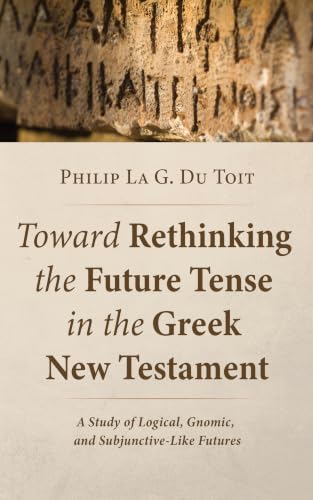
By building on the theory that the Greek future tense indicates relative time rather than absolute time, and that it points to an occurrence subsequent to some reference point, this study is aimed at rethinking the way in which the future tense is used in the Greek New Testament. One of the central questions that is asked is if the gnomic and logical future uses of the future are as rare as is normally perceived. Are the designations "gnomic" and logical" referring to the same aspect or different aspects? In this book, the criteria that are used to identify and describe the gnomic, logical, and subjunctive-like uses of the future tense are refined and further developed.
$36.29
Toward Rethinking the Future Tense in the Greek New Testament—
$36.29
Toward Rethinking the Future Tense in the Greek New Testament
By building on the theory that the Greek future tense indicates relative time rather than absolute time, and that it points to an occurrence subsequent to some reference point, this study is aimed at rethinking the way in which the future tense is used in the Greek New Testament. One of the central questions that is asked is if the gnomic and logical future uses of the future are as rare as is normally perceived. Are the designations "gnomic" and logical" referring to the same aspect or different aspects? In this book, the criteria that are used to identify and describe the gnomic, logical, and subjunctive-like uses of the future tense are refined and further developed.
Product Information
Product Information
Shipping & Returns
Shipping & Returns
Description
By building on the theory that the Greek future tense indicates relative time rather than absolute time, and that it points to an occurrence subsequent to some reference point, this study is aimed at rethinking the way in which the future tense is used in the Greek New Testament. One of the central questions that is asked is if the gnomic and logical future uses of the future are as rare as is normally perceived. Are the designations "gnomic" and logical" referring to the same aspect or different aspects? In this book, the criteria that are used to identify and describe the gnomic, logical, and subjunctive-like uses of the future tense are refined and further developed.